
Nature Doesn't Hustle
The trees and the turning of the seasons have always shown us a better way—here's how we start to see it again

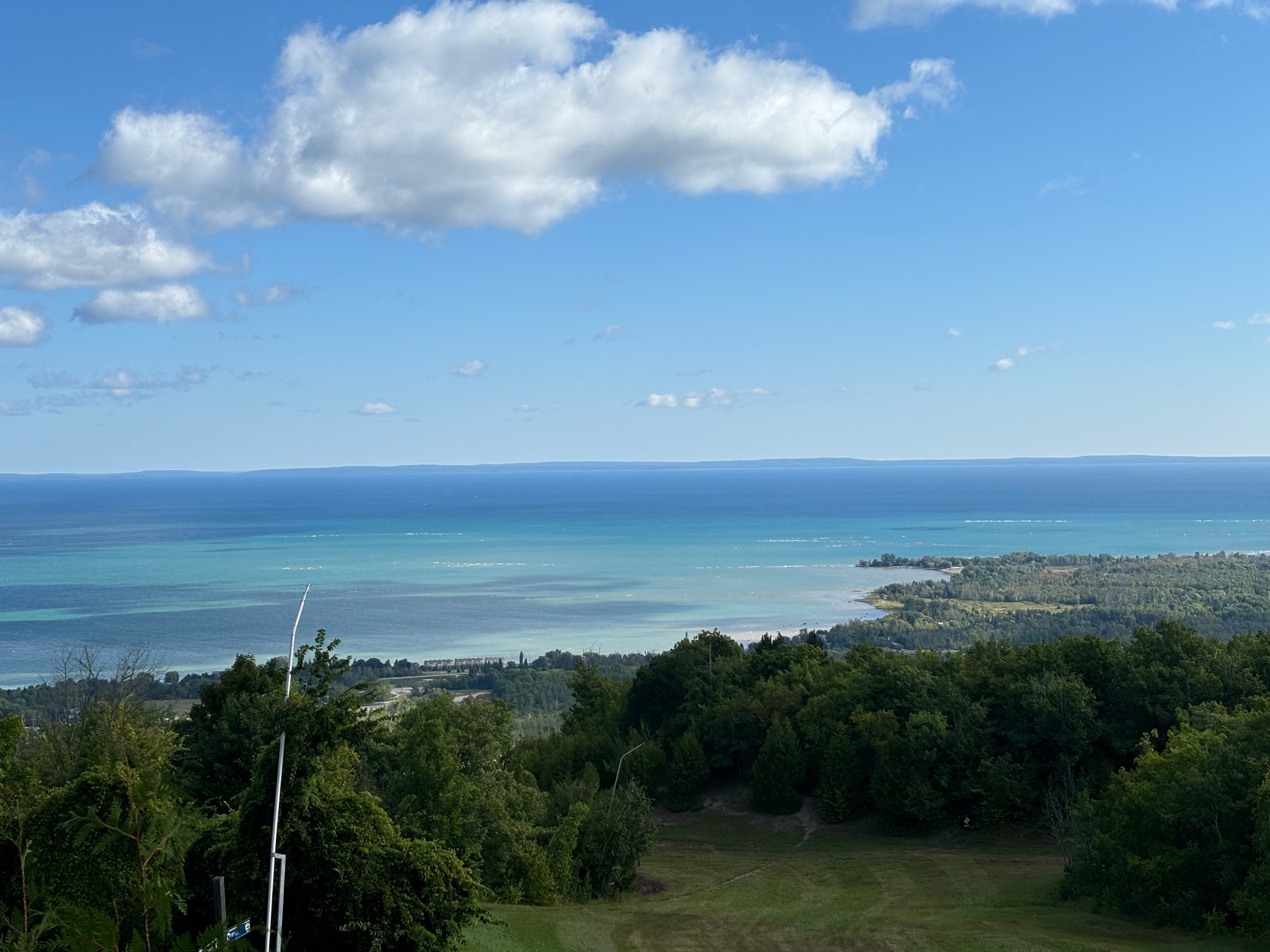
In the summer of 2024, I moved to the shores of Georgian Bay in Ontario, Canada—15,000 square kilometers (nearly 6,000 square miles) of crystal-clear waters stretching out as far as the eye can see. It’s a vast arm of Lake Huron, often called ‘Canada’s Sixth Great Lake’, in a region informally referred to as the ‘West Coast’ of Ontario.
It feels a lot like living near the ocean—minus the saltwater and sharks.
Living here had been a distant ‘someday’ idea on my bucket list for a long time. But actually doing it—picking up my life after over fifty (!) years of living in my hometown, and starting from scratch knowing barely anyone here—turned out to be one of the best things I’ve ever done for myself.
Not just because of the four-season town’s charm and the friendly people—although I do love those too—but because of everything that surrounds it.
Within five to twenty minutes (at most) in any direction, I’m fully surrounded by nature: a world that’s wild and alive and indifferent to anyone’s schedule or to-do list. Trails that climb through forests of trees that are hundreds of years old, where dappled light dances through the maples, oaks, and pines. A vast blue bay that changes color and character with the winds and the skies. Hills that were here long before even the Chippewas, Haudenosaunee, Anishinaabe and other Indigenous peoples who first cared for this land.
It wasn’t long after I moved here that I realized I hadn’t understood just how much I’d needed more nature in my life—until I felt the deep influence of being surrounded by and more connected to it.
The pace of the city
Before living here, I’d spent most of my life in various suburbs of a mid-sized metropolitan area. Don’t get me wrong; I’m not anti-city—there’s a genuine vitality and diversity in urban life, and I can see how people can come to miss it—
But cities are optimized for production and logistics. Everything about them is organized around doing: moving, transacting, consuming, performing, achieving. The rhythms are largely human-made. The light is artificial. The pace is fast—and rarely slows.
After enough years in an environment like that, you start to forget that there’s another kind of environment. Another kind of rhythm. A different way of life. One that has nothing to do with quarterly targets or getting everyone out the door every morning or how many things you can cross off your to-do list in twenty-four hours.
You forget that the planet has sustained itself for a very long time, running on very different operating systems than the ones we’ve constructed.
The operating system we dropped from the curriculum
When you spend time in nature—not the Insta-worthy photo-op kind of time, where you hike somewhere pretty just to snap a selfie before you hustle back to the car, but the slower, wandering, curious kind of time—time when you stop to sit and actually take a look around you, both at up-close things and at the view in the distance—you start to notice something.
Nature never hustles.
The trees never stress about their growth rate compared to the ones next to them. The water doesn’t apologize for taking its time to warm up in the spring. The seasons don’t get expedited because somebody decided winter was inconvenient.
Everything moves in cycles. Everything has a rhythm of expansion and contraction, growth and rest, creation and dissolution.
People’s lives used to follow more of these same rhythms too.
Before the industrial revolution reorganized human life around the punch clock and the factory whistle all conducted beneath fluorescent lighting, most of us lived close enough to the natural world that our days and lives aligned more fully with the Earth’s rhythms.
You worked when it was light. You rested when it was dark. You sowed in spring, tended in summer, harvested in autumn, and slowed down in winter. You knew—with the deep kind of knowing you feel in your bones—that fallow ground and dormant seeds are not signs of idleness or apathy or failure—they’re an essential part of the cycles of life.
The wisdom in those cycles hasn’t become outdated or irrelevant. We’ve just stopped paying attention to it. And there are important lessons we can glean from it about how to live a life well.
Lessons that have been hiding in plain sight the whole time.
Waiting for us to remember.
What the seasons can teach us about the times we’re in now
I’m not saying we should all go back to the dark ages and live by candlelight, or that all of us should migrate to the latitudinal climate ranges most conducive to a healthy human life. But when I zoom out and look at the broader picture of everything that’s happening here on Earth right now, it’s easier to see what kind of season we’re in.
Which can help us navigate it with more wisdom and less fear.
Collectively, culturally, and for many people personally too, we’re heading into a winter season (yes, even though at the time of this writing the Northern Hemisphere is meteorologically heading into summer). Many of our current-day ways of living, systems of operating, and the processes and protocols we’ve come to rely on for navigating life and governing societies are starting to break down and beginning to fall away.
Many of the things that helped us flourish over recent decades have taken on a life of their own. Many have become bloated, or corrupted, or outdated—and are rightfully coming to the end of their useful life.
We can all agree that there are a lot of things that need to change. We can all feel all the things that don’t feel quite right anymore (if they ever did).
The seasons can help us remember that change doesn’t have to be scary.
As we head into a socio-economic-cultural-collective winter of sorts, we can remember that winter isn’t just the absence of the abundance and plentitude of spring or summer—it’s the necessary season that precedes them. A lot of what’s happening right now—the dissolution of old structures, the disruption of old systems, the disorientation we feel when the old footing falls away—is just winter doing its necessary work.
It’s a time when what needs to rest, rests; when what needs to die off, dies off; and when ‘what was’ falls down to the ground so that—given the right amount of time and the right conditions—the earth can begin to decompose and then recompose it all in a way that nourishes the new life that’s about to come next.
Nature transforms and reintegrates what’s fallen, and it prepares itself underground in ways that are invisible to the eye but essential to the process.
If you’ve ever grown anything, you know this. You don’t plant seeds into exhausted, depleted soil and expect them to thrive. Old growth needs to be cut back or pruned off, and the soil given rest and nourishment, in order to create the space and conditions in which new life can thrive. The fallow period is not wasted time. It’s just productive in a way that doesn’t look like productivity.
What it looks like is death.
But it’s actually the time for us to figure out what we want to plant next.
So instead of dwelling in the idea that this collective winter is ‘destroying’ everything we’ve come to know, what if instead we were to work together? To clear away the brush we can all see needs to be removed, keep all the parts that nourish and strengthen us, and decide what kinds of seeds we want to plant and nurture so that everything—not just everyone, as in all people, but everything as in biological, ecological, geological—would be able to thrive in this next season of life that lies ahead?
To help us find these answers, I look to the trees.
If the trees could speak
Standing in the forests here among the myriad of tree species, I can see and feel the truth of how they all work together, as both ancient wisdom and modern science have taught us.
Trees share resources to support each other. Trees share nutrients and water, dividing it optimally among them so that they can all get what they need. They recognize the advantages in working together rather than against each other. And when assisted by the stewardship of other species—the insects and animals that spread seeds, pollinate flowers, and enrich the soil, as well as humans that assist with selective and moderate caretaking—it creates a healthier environment for all.
“...all gifts are multiplied in relationship. This is how the world keeps going.”
~Robin Wall Kimmerer, from Braiding Sweetgrass
Trees communicate because they need each other. This is not a metaphor—it’s documented biology. Trees in a healthy forest share nutrients and information through fungal networks below the surface. The most resilient ecosystems are not the ones where each organism is maximizing for its own individual benefit. They’re the ones where everything works in relationship with everything else. Silently, through an interconnected web, needs and resources are communicated and shared so that all neighbours are supported.
“On its own, a tree...is at the mercy of wind and weather. But together, many trees create an ecosystem that moderates extremes...”
~ Peter Wohlleben, The Hidden Life of Trees
And in all of nature, the most dramatic growth often happens invisibly. The seed buried deep in the soil. The caterpillar in the chrysalis. The forest floor beneath the winter snow. What looks like nothing from the outside—what often looks like death and dying—is where the most important work of creation is being done.
Now the question is how to put this into practice.
Knowledge is not power
Knowing these principles is only the first step. Putting that knowledge into practice is where the real wisdom lies. I find myself thinking about this a lot when I think about where we’re headed as a society. Where I’d like to see us go.
Here’s what I recommend as the most practical way for you to start to turn these metaphorical and philosophical thought exercises into real-world practice in your life:
Anytime you feel stuck or are going through an unsettling or confusing season, be like a tree: get outside and into nature—ideally among other trees. While the real thing is always better for getting the full sensory experience, even if you can’t get outside, watching nature on-screen still delivers measurable benefits—your visual system can’t fully distinguish between the real thing and a high-quality representation of it. Use that to your advantage.
When you bring your full attention and all of your physical senses to your surroundings, the urgencies and anxieties that felt overwhelming just minutes earlier quickly begin to soften. Your mind begins to calm down. Adding slow, deep breaths to the mix will multiply these positive effects.
Watching the way the light moves through the leaves, or listening to the sound of moving water, or smelling the fragrance of fresh earth creates physical, mental and psychological benefits that have plenty of documented and legitimate science behind them: measurable reductions in cortisol, improvements in mood and cognitive function, and restoration of attention.
It works. It’s free. And it’s available to almost anyone, anywhere, anytime.
Beyond the immediate reset that nature offers, there’s a longer practice worth building too. Try returning to the same place across different seasons—a particular trail, a favourite bench by the water, a tree in your backyard or a nearby park. What changes from one visit to the next? What stays the same? You’ll start to develop a felt sense of the cycles—not just intellectually, but in your body—and that felt sense becomes a resource you can draw on when things feel chaotic or unclear.
You can also try bringing a question with you. Not to force an answer, but to hold it loosely while you walk or sit as you’re directing your attention not to the question but to nature. Something you’ve been circling around, something that hasn’t resolved itself despite all your thinking about it. There’s something about the particular quality of attention that nature invites from us—slower, wider, less directed—that creates the kinds of conditions for insight that focused, screen-based thinking rarely does. The answer won’t always come during the walk. But it will often come sometime after.
And finally: notice the things you’re drawn to in nature. Which tree calls to you. Which view makes you stop in your tracks. Which sounds make you slow down. These aren’t random—the things that catch your attention in nature are often indicators of something you need. Rest. Perspective. Rootedness. Connection. Space. Song. Celebration.
Nature has been sending us messages for a very long time. We just need to remember—and practice—how to receive them.
Closing words from our friends in the forests
Many of the views stopped me in my tracks during my first summer here, but the one at top of this post is one that took my breath away. At the top of the Niagara Escarpment I’d come out to a clearing where I could see across the entire bay, and if I had to put into words the message that I felt from the natural world—a message that I’ve kept hearing her repeat, in every season and every ecosystem and every cycle of growth and rest—it might have gone something like this:
You belong here. You are part of this big, beautiful world. And the same intelligence that runs through everything else runs through you too.
It’s an important truth for each of us to remember. Especially right now, when so much of what we’ve built our modern-day sense of belonging around is being restructured.
The ground is still beneath your feet. The seasons are still turning. Think about what kinds of seeds you’d like to sow and to see flourish in the new world that’s taking shape right now, just beneath the surface, under what sometimes look like death and dying—and remember that spring always comes, even after the longest, hardest winter.
Let’s gently become together. 💛
Kelly
P.S. Subscribe below if you haven’t yet—and if someone in your life could use a reminder to slow down and remember that they’re part of something bigger, share this with them. Plus, join me for an upcoming Dreamsmith retreat, where nature is always included. Get on the waitlist for the next one at kellywagnerkw.com/retreats
Some links here are affiliate links, which means if you choose to buy through them, I may earn a small commission. This is never at any additional cost to you, and it’s a simple way you can help support the work I share here. Thank you for your support; I'm truly grateful for it.
I just recently wrote about nature and posted it. It’s titled May 22, 2026… unique title, right? 😅 I’d love for you to read it if you feel called to, as I share a bit about my life.
I love that you moved your life after the age of 50 to somewhere you didn’t know many people. For a long time, my soul has called to the water, trees, mountains.
Life had other plans, of which I wouldn’t change. However, as noted in my article above, I’m now asking questions about the second half of my life, putting myself back into the equation, and the water still calls to me, beach towns, cottage country… I do believe part of my soul calling is tied to water.
Albeit, I would have such a terrible time leaving my grown children. (My timeline would maybe be 2–5 years from now.) But I’ve known for so long that it’s where I’ve wanted to be, circumstances just haven’t allowed it.
Nature holds me a lot during transition. I would love to experience the vastness like you are able to.
I live in a city, and we have coulees nearby. I’ve never visited Ontario (TO for work) before, but it sounds beautiful. I’ve been to both the east and west coasts of Canada and personally prefer the east.
If you could pick 3–5 spots in Canada, or even just Ontario, for the water, scenery, nature, and overall feeling… what would you choose, and why?
2025 was a winter year for me. A year of pruning that felt like death but I knew it was what God had for me. And He had been planting new seeds this year and it feels like spring! I started writing and worshipping with music again! I love “Nature doesn’t hustle.” Very true. I’m going to add it to my list of quotes right next to…ruthlessly illuminating hurry from my life!